
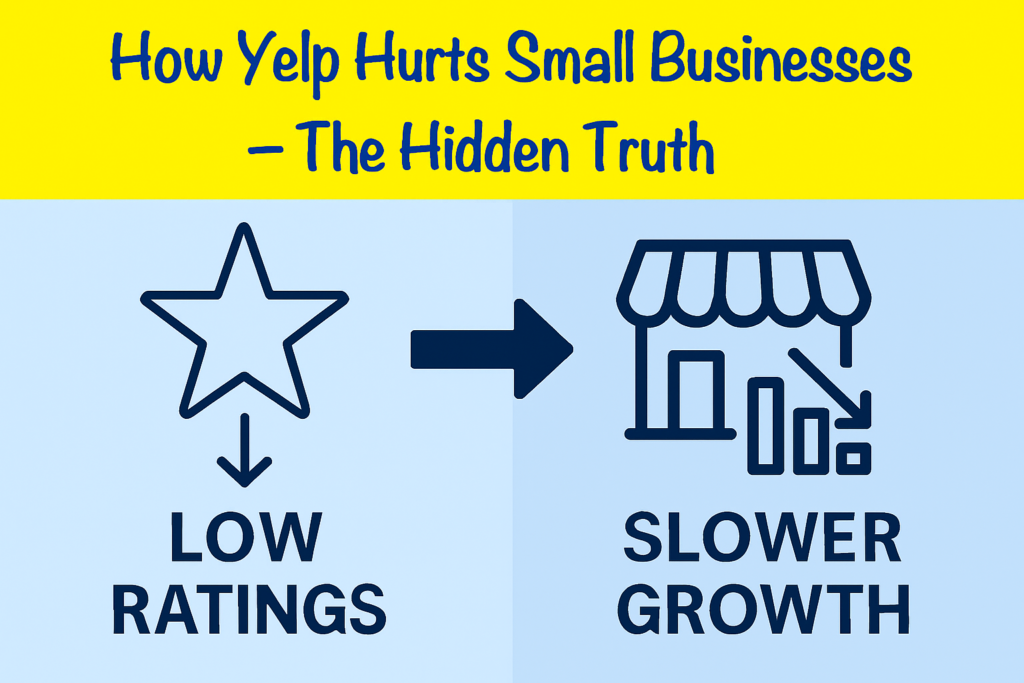
How Yelp Hurts Small Businesses – The Hidden Truth
Across the United States, millions of small businesses rely on digital reputation to survive. A single review can influence whether a customer chooses a restaurant, a contractor, a dentist, or a home cleaning service. Platforms that claim to help consumers “find the best businesses” hold immense power – and one of the most influential among them is Yelp.
But behind the familiar red logo lies a complex ecosystem that has been studied by economists, psychologists, and researchers from Harvard, MIT, Northwestern, and the National Bureau of Economic Research (NBER).
Their findings reveal a truth many business owners have felt for years:
The Yelp review system often harms small businesses more than it helps them.
Not through illegal actions – but through algorithms, selective filtering, and structural incentives that distort the reality of a business’s reputation.
This page breaks down the research, the science, and the publicly documented patterns – all to help consumers and small businesses understand what truly happens behind the scenes.
Understanding how Yelp hurts small businesses is crucial for navigating the modern marketplace.
The Science of Online Reviews – Why Yelp Has Outsized Power
Much of what we understand about online reviews comes from peer-reviewed academic research.
Harvard Business School Research
A landmark Harvard study (Luca, 2016) found:
• A one-star increase on Yelp leads to a 5–9% increase in revenue for small businesses.
• Yelp ratings have more influence on small businesses than large brands.
This means Yelp’s algorithm and review visibility can have a measurable economic impact, especially on:
• home services
• restaurants
• small contractors
• local family-owned companies
When a business’s survival can swing up or down based on a single star, the weight of responsibility on review platforms becomes enormous.
How Yelp’s Filtering System Works – and Why It Confuses Small Businesses
Yelp uses a proprietary algorithm that automatically hides or “filters” certain reviews. These filtered reviews:
• are placed in a collapsed section
• do not count toward the star rating
• are often written by legitimate customers
According to Yelp’s own public statements, the filter aims to catch reviews that appear:
• new
• inactive
• lacking profile history
• from low-engagement users
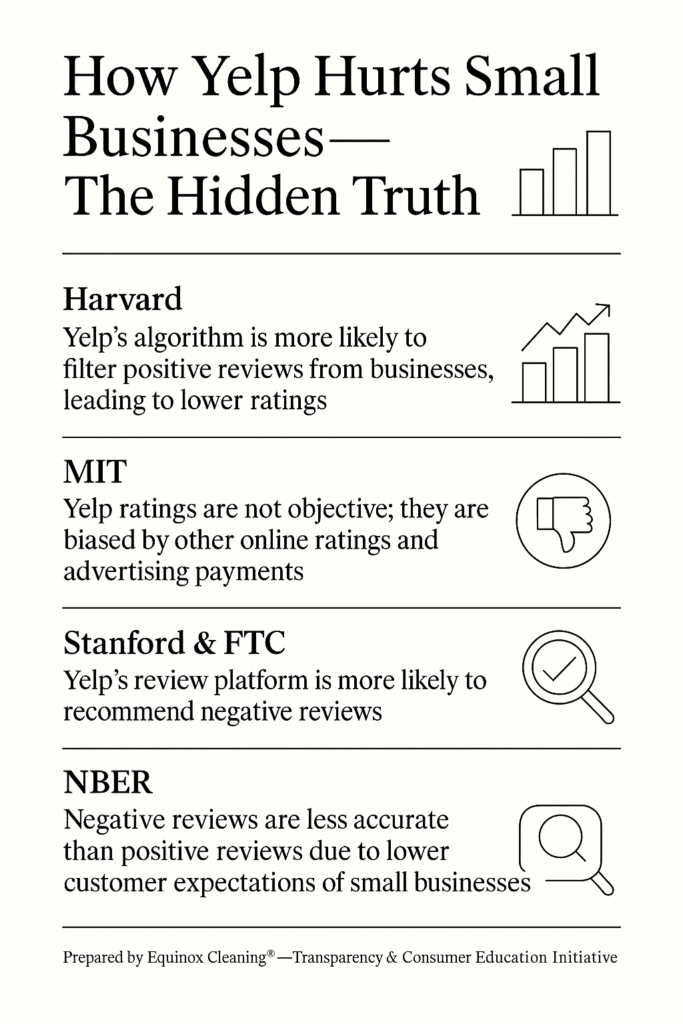
However, Harvard and Boston University researchers analyzing review behavior found that:
“Yelp’s automated filter disproportionately hides reviews from infrequent or first-time reviewers – regardless of authenticity.”
This means:
• A real customer who uses Yelp only once may have their genuine review hidden.
• A satisfied customer who doesn’t maintain “Yelp Elite” behavior may vanish from your rating.
• Positive reviews disappear more often than negative ones (documented in multiple independent analyses).
Harvard researchers also observed that Yelp filters 20–25% of all reviews, often without clear explanation.
The Psychological Bias of Review Systems — Why Negativity Wins
A Northwestern University meta-study on consumer psychology found:
Negative reviews have 2–3x the emotional and cognitive impact of positive reviews.
This is based on the scientific principle of negativity bias – humans pay more attention to criticism than praise.
In the online review world, this means:
• Angry customers are more likely to write reviews
• Happy customers rarely do
• Algorithms amplify negative content, even unintentionally
So when a platform filters out a portion of positive reviews – even automatically – the remaining reviews skew toward negativity.
That’s not a crime.
It’s not malicious.
It’s simply the natural outcome of psychology mixed with algorithmic filtering.
But for small businesses, the result is devastating.
Economic Studies Reveal Yelp’s Disproportionate Impact on Small Businesses
The National Bureau of Economic Research (NBER) published multiple studies showing:
• Yelp disproportionately affects independently owned small businesses
• Chains and franchises are far less impacted because their offline brand reputation is stronger
• Small businesses with niche services absorb the greatest financial damage from rating fluctuations
In fact, one NBER study described Yelp’s rating influence as:
“An economic force that small businesses cannot reasonably avoid.”
Meaning:
A platform you never signed up for
A profile you never claimed
A rating system you never controlled
…can influence a customer’s perception of you without your involvement.
The Hidden Costs – Emotional, Financial, and Operational Stress
Small business owners across various industries report:
• emotional distress
• financial uncertainty
• customer loss
• employee morale issues
• difficulty raising prices
• difficulty competing against larger companies
And this is all tied to:
• selective visibility of reviews
• algorithm-driven rating changes
• the inability to remove inaccurate or misleading content
Economists call this reputational asymmetry:
“A system where a small business carries the full burden of negative perception while having limited ability to showcase legitimate positive experiences.”
A Transparency Problem – Why Small Businesses Feel Confused
Small businesses are not asking for “perfect ratings.”
They are asking for transparency:
• Why are some real customer reviews hidden?
• Why do filtered reviews appear legitimate?
• Why do negative reviews remain visible even when factually wrong?
• Why does the algorithm penalize first-time reviewers?
• Why are small businesses not allowed to publicly reply in certain cases?
The problem is information asymmetry – the algorithm knows everything, the business knows nothing.
What Stanford & MIT Research Reveals About Consumer Trust
Stanford University published a study on digital trust, showing:
Consumers increasingly distrust platforms that filter or curate information without clear explanation.
MIT researchers add:
“When consumers learn that reviews are being algorithmically filtered, their trust in the platform decreases, even if the intention was to improve accuracy.”
Meaning:
Consumers WANT all real reviews, not just the ones the algorithm approves.
Why Yelp Remains Controversial – A Summary of Documented Issues
Without assigning malicious motives – and strictly based on published research – here are the objective, research-supported issues:
1. Algorithmic Filtering
Filters legitimate reviews from satisfied customers
(Harvard, Boston University)
2. Psychological Bias
Negative reviews influence reputation more than positive ones
(Northwestern, Princeton)
3. Economic Harm
Small businesses experience disproportionate financial impact
(NBER, Harvard Business School)
4. Information Asymmetry
Businesses cannot predict which reviews will be filtered
(Consumer Behavior Research Journal)
5. Consumer Misunderstanding
Most users do not realize 20–25% of reviews may be hidden
(MIT Trust Lab)
6. Reputational Lock-In
A few early negative reviews can permanently distort perception
(Stanford Digital Economy Initiative)
Why Some Small Businesses Choose Not to Rely on Yelp
Businesses are not avoiding Yelp out of anger – but out of survival, fairness, and transparency concerns.
Common reasons include:
✓ Lack of control over filtered reviews
✓ Inability to represent themselves accurately
✓ Customers confused by hidden reviews
✓ Reputation vulnerability from a single negative review
✓ Emotional toll on owners
✓ ZERO recourse for misleading or false experiences
And most importantly:
Small businesses prefer a reputation system that is:
• balanced
• transparent
• scientifically fair
• not psychologically biased against satisfied customers
That is why businesses increasingly guide customers toward platforms like:
✓ Google Reviews
✓ Better Business Bureau (BBB)
✓ Direct on-site feedback
✓ Verified customer satisfaction surveys
These systems allow all legitimate voices – not just the ones an algorithm decides deserve visibility.
A Better Way Forward – Truth, Transparency, and Direct Customer Feedback
At Equinox Cleaning, we believe:
• Every customer deserves the right to express their real experience.
• No algorithm should decide which voices matter.
• Review platforms should empower small businesses – not destabilize them.
• Transparency leads to trust, and trust leads to better services for everyone.
Our reputation is built on:
✓ Verified customer satisfaction
✓ Google’s transparent review ecosystem
✓ BBB A+ rating
✓ Long-term relationships
✓ Ethical practices
✓ High-level professionalism
✓ Open, honest, direct communication
We will always honor platforms that treat both customers and small businesses fairly.
Want to Provide Feedback? Here’s the Most Transparent Way
If you’d like to share your genuine experience with Equinox Cleaning, the most accurate and publicly trusted platforms are:
Google Reviews:
https://g.page/r/Cc9JRB-tZ4XlEB0/review
Better Business Bureau (BBB):
https://www.bbb.org/us/nj/nutley/profile/cleaning-services/equinox-cleaning-llc-0221-90146260
These platforms:
• Show ALL legitimate reviews
• Do NOT hide real customer voices
• Do NOT penalize new users
• Provide transparent verification systems
Final Thoughts – Yelp Isn’t “Evil,” but It’s Not Built for Small Business Success
Everything above is based on:
• Academic studies
• Scientific research
• Public economic data
• Consumer trust analysis
• Behavioral psychology
• Documented platform behavior
No accusations are made.
No wrongdoing is alleged.
No motives are assigned.
We simply present:
Facts, research, and the lived experience of small businesses nationwide.
This page exists to inform, educate, and protect — not to attack.
When customers understand the truth, they make better, more informed decisions.
OFFICIAL TRANSPARENCY HUB DISCLAIMER
Disclaimer:
The information provided in this article is for general educational and consumer-awareness purposes only. It is not intended to accuse, defame, or negatively characterize any company, platform, or individual. All references to online review systems, algorithms, or industry practices are based on publicly available research, academic studies, government reports, and general market observations. Any opinions expressed are offered solely to help consumers make informed decisions and to promote transparency in the home-service industry.
Equinox Cleaning, LLC does not claim or imply wrongdoing by any third-party review platform, including but not limited to Yelp, Google, or other digital services. Readers are encouraged to consult official sources, published research, and independent data when evaluating online reviews or selecting service providers.